
Signs of autism in Children
Autism Spectrum Disorder (ASD) is a neurodevelopmental condition that affects how a child communicates, interacts socially, and responds to their environment. According to the CDC, approximately 1 in 36 children in the United States is diagnosed with ASD — and Indian prevalence studies estimate 1 in 68 children. Early signs can appear as young as 6 to 12 months and a reliable diagnosis is possible by age 2. Early identification and intervention significantly improve long-term outcomes.
Every child develops at their own pace. But some differences in how a child communicates, plays, or responds to others may be early signs of Autism Spectrum Disorder. Recognising these signs early — during what specialists call the “Golden Window” of brain development — gives children access to therapies that can make a meaningful difference. This guide covers the key red flags by age, what to look for, and when to seek professional evaluation.
What is Autism Spectrum Disorder (ASD)?
Autism Spectrum Disorder is a complex neurodevelopmental condition that affects social communication, behavior, and sensory processing. It is called a “spectrum” because it presents very differently from child to child — some children may have exceptional abilities in specific areas while struggling with social interaction, while others may face challenges with verbal communication or adapting to change.
The earlier ASD is identified, the more effective the intervention. Brain plasticity — the brain’s ability to reorganise and adapt — is highest in the first few years of life, making early therapy significantly more impactful than intervention started later.
Age-by-Age Red Flags for Autism
The following table outlines key developmental milestones and autism warning signs by age. Missing multiple milestones in the same age band warrants a professional evaluation.
Age | Typical Milestone | Autism Red Flag |
6 months | Social smile, eye contact | Rarely smiles, avoids eye contact |
9 months | Responds to own name | Does not turn when name is called |
12 months | Points, waves, reaches up | No pointing, waving, or gesturing |
16 months | Says single words | No single words spoken |
18 months | Follows simple instructions | Does not respond to simple requests |
24 months | Uses 2-word phrases | No 2-word phrases, speech regression |
3–5 years | Imaginative play, peer interaction | Prefers solitary play, no pretend play |
School age | Understands social rules | Difficulty with unwritten social rules |
Early Signs: Birth to 18 Months
Social Smile and Eye Contact
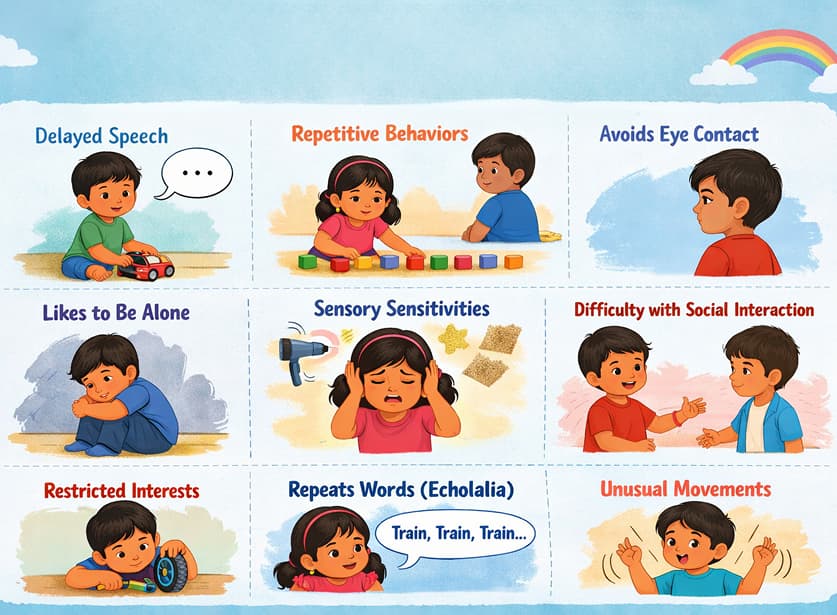
By 6 to 9 months, most infants smile back at a parent’s face and begin to maintain eye contact. A child showing early signs of autism may rarely make eye contact, not respond with a smile by 6 months, or appear more interested in objects than in people.
Response to Name
One of the most consistent early indicators of ASD is not responding when called by name — even though the child’s hearing is completely normal. Most babies recognise and turn toward their name by 9 months. If this is absent or inconsistent by 12 months, it warrants attention.
Pointing and Gesturing
Communication starts long before words. By 12 months, most toddlers point at things they want, wave goodbye, and reach out to be picked up. The pointing milestone is particularly important — a child who does not point to share interest in something (like pointing at a bird to show a parent) by 14 months should be evaluated by a pediatric specialist.
Communication and Language Signs
Speech Delay and Regression
A speech delay alone does not mean a child has autism. However, when speech delay is combined with reduced eye contact, lack of gesturing, and limited social interaction, it is a stronger indicator. Any regression in language — a child who was saying words and then stops — should be evaluated immediately regardless of age.
Echolalia
Some children with autism repeat words or phrases they have heard — from a parent, a TV show, or a book. This is called echolalia. While all toddlers do this briefly during language development, in autism it persists longer and is often used without clear communicative intent.
Literal Understanding of Language
Children with ASD often take language very literally. They may not understand jokes, sarcasm, or figurative phrases. A child told to “pull your socks up” may look down at their socks in genuine confusion.
Social Interaction Signs
Difficulty with Peer Relationships
As children enter school, social demands increase significantly. Children with ASD may prefer playing alone, struggle to understand the unwritten rules of group play, or find it difficult to take turns. They may want friends but not know how to initiate or maintain those friendships.
Limited Imaginative Play
Most children naturally engage in pretend play — feeding a doll, pretending a block is a car, or acting out scenarios. Children with ASD often find imaginative play difficult and may instead line up toys, sort objects by colour, or repeat the same play pattern exactly.
Intense Focused Interests
Many children on the spectrum develop a deep, consuming interest in one specific topic — train schedules, dinosaurs, astronomy, or a particular TV series. While intense interests are not harmful, they become notable when they dominate most of the child’s attention and conversation to the exclusion of other topics.
Sensory Processing Signs
For many children with ASD, the world can feel overwhelming. The brain either over-responds or under-responds to sensory input — light, sound, touch, taste, or smell.
Hypersensitivity (over-responsive):
- Covering ears at everyday sounds like a vacuum cleaner or hand dryer
- Distress at the texture of certain foods or fabrics
- Finding clothing tags or seams painful
- Meltdowns triggered by sensory overload — distinct from typical tantrums
Hyposensitivity (under-responsive):
- Spinning without getting dizzy
- Touching objects or people constantly
- High pain threshold — barely reacting to bumps or scrapes
- Seeking out intense sensory input like tight squeezes or rough textures
Repetitive Behaviors and Need for Sameness
Repetitive behaviors — often called “stimming” — are a core feature of ASD. They serve as a way for the child to self-regulate in a world that feels unpredictable or overwhelming.
Common stimming behaviors include hand flapping, finger flicking, rocking back and forth, toe walking, and repeating sounds or phrases.
Children with ASD often also have a strong need for routine and sameness. Even small changes — a different route to school, a substitute teacher, or a new brand of food — can cause significant distress. The intensity of this need is much stronger than typical toddler preference for routine.
Why Early Intervention Matters
Early intervention does not aim to “fix” a child — it aims to give them the tools to navigate the world more comfortably and confidently. Therapies that are most effective when started early include:
- Speech Therapy — builds communication strategies for verbal and non-verbal children
- Occupational Therapy — helps manage sensory sensitivities and develop daily living skills
- Applied Behavior Analysis (ABA) — supports learning of social and communication skills
- Social Skills Training — teaches the unwritten rules of interaction in a structured way
The Indian Academy of Pediatrics recommends developmental screening at every well-child visit from 9 months onward, with specific autism screening using the M-CHAT-R/F tool at the 18-month and 24-month checkups.
Final Thought
Recognising the signs of autism early is one of the most important things a parent can do for their child’s future. A diagnosis is not a limitation — it is a roadmap that opens the door to the right support, therapies, and understanding.
If you have any concerns about your child’s development — speech, social interaction, behavior, or sensory responses — do not wait for certainty before seeking guidance. Trust your instincts and speak with our pediatric team at Rishitha Hospitals for a developmental assessment.
FAQs
1. At what age can autism be reliably diagnosed?
Some signs appear as early as 6–12 months, but a reliable diagnosis can usually be made by age 2, though many children aren’t diagnosed until they’re older.
2. Is a speech delay always a sign of autism?
No — many children have isolated speech delays without having autism, unless it’s accompanied by challenges in social interaction and repetitive behaviours.
3. Why is autism more commonly diagnosed in boys than girls?
Diagnostic criteria were historically based on how boys manifest symptoms, while girls often mask or camouflage theirs, leading to later diagnoses.
4. Can vaccines cause autism?
No — extensive global research has consistently shown no link between vaccines and autism, which is influenced by genetic and environmental factors before birth.
5. What is the first step if I suspect my child has autism?
Schedule a developmental screening with a paediatrician, who may use standardised tools like the M-CHAT to decide if further evaluation is needed.
Medical Disclaimer : This content is for general informational purposes only and is not a substitute for professional medical advice, diagnosis, or treatment. Every child develops differently, and autism can only be properly diagnosed through evaluation by a qualified pediatrician or developmental specialist. Never disregard professional medical advice or delay seeking treatment based on information read here. If you notice developmental concerns in your child, please consult Rishitha Hospitals directly.